How to use the 80-20 rule to simplify your life and protect your energy
Written by Amy Orsini, Reiki Master Teacher, Sound Practitioner & Life Coach at Three Little Birds, Purley, London.
Have you ever had one of those moments where you look at your life and think, “Why does everything feel so much more complicated than it needs to be?”
The list is long. The tabs are open. The washing is there. The emails are there. The half-finished jobs are there. The social media post you were going to write three days ago is still floating around in your head. And somehow, even though you are doing all the things, you don’t necessarily feel like you’re moving forward.
It’s exhausting, isn’t it?
This is where the 80-20 rule can be really helpful.
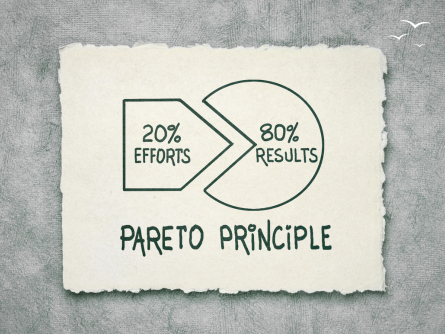
You might have heard of it before. It’s also known as the Pareto Principle, and the basic idea is that roughly 80% of your results come from 20% of your efforts.
It isn’t a perfect mathematical rule for every single situation. Sometimes it might be 70-30 or 90-10. But the point is this: not everything you do has the same impact.
Some things really move things forward. Some things bring you joy. Some things support your wellbeing. Some things help your business grow.
And some things, if we’re being honest, are just noise.
The 80-20 rule is not about being lazy
Let’s clear this up straight away. This is not about doing less for the sake of doing less. It’s not about cutting corners, ignoring responsibilities or pretending things don’t matter when they do.
It’s about becoming more intentional with your focus and your energy.
Because your energy is precious. Your time is precious. Your attention is precious. And if you’re pouring most of it into things that don’t really support you, don’t bring you joy, don’t move your business forward, don’t deepen your relationships and don’t help you feel better, it might be time to gently question that.
Not in a harsh way. Not in a “you’re doing life wrong” way. Just with curiosity.
What actually moves things forward?
This is one of the most useful questions you can ask yourself: what actually moves things forward for me?
In business, it might not be spending four days perfecting a logo on Canva. (No judgement. I see you, and I have absolutely been there!)
It might be having a real conversation with someone who is interested in working with you. It might be sending the email. It might be recording the podcast. It might be showing your face on social media because, as annoying as it might feel sometimes, people want to know who they’re dealing with.
Especially when your business is personal. Especially when you are the face of it. Especially when you’re offering something like Reiki, coaching or sound baths where people are not just buying a thing - they’re choosing a space, an energy, a person they feel safe with.
So in business, the 80-20 rule invites you to ask: what brings connection? What helps people understand what I do? What helps people feel safe enough to take the next step? What content gets the most engagement? What emails do people reply to? What offers do people ask about?
You don’t need to do everything. You need to notice what works.
Your 20% of wellbeing habits
The 80-20 rule is not just useful for business. It’s really helpful for your wellbeing too.
There are probably a handful of habits that make the biggest difference to how you feel. For me, those things include Reiki, yoga, sound, journaling, gratitude, meditation, breathwork, walking outside in nature, moving my body, connecting deeply with people and deleting the things that drain my energy.
Your list might be different.
Maybe your 20% is going to bed earlier. Eating proper meals. Walking outside without your phone. Having one honest conversation. Doing ten minutes of stretching. Writing down what’s in your head. Taking a break from the news. Booking the Reiki session. Going to the sound bath. Sitting quietly with a cup of tea before everyone needs you.
It doesn’t have to be dramatic. In fact, it probably won’t be. Often, the things that support us most are very simple. The problem is that we overlook them because they seem too easy.
But simple does not mean ineffective.
What thoughts are creating most of your stress?
This one is a bit uncomfortable, but it’s important.
What 20% of your thoughts are creating most of your stress?
Because your thoughts are part of how you spend your energy. If you are constantly replaying a conversation, worrying about what someone thinks, imagining everything that could go wrong, or mentally carrying responsibilities that are not actually yours, that is taking energy from you.
And your body feels that. Your nervous system feels that. Your mood, your sleep, your patience, your creativity and your ability to enjoy your life can all be affected by the thoughts you keep feeding.
So this is your gentle invitation to notice.
What do you keep thinking about? Is it useful? Is it helping? Is it producing clarity, or is it producing worry?
Don’t judge yourself for it. Awareness is enough to begin with. Once you can see it, you can start choosing differently.
Look at your relationships
Here’s a big one.
What 20% of your relationships bring you most of your joy, support, laughter, growth and sense of belonging?
We can get so caught up in numbers. Followers. Contacts. Group chats. People we “should” see. People we’ve known forever. People we feel guilty about not spending time with.
But connection is not about quantity. It’s about quality.
Who do you feel lighter around? Who helps you feel more like yourself? Who inspires you? Who respects your boundaries? Who makes you laugh until your face hurts? Who helps you grow without making you feel like you’re not enough as you are?
Those are the relationships worth investing in.
And maybe there are other relationships that don’t need to be cut off or made dramatic, but they do need less of your time, less of your emotional energy, less access to your inner world.
That’s allowed.
Your time is not something you have to hand out equally to everyone.
Your calendar tells the truth
If you want to know what you’re prioritising, look at your calendar.
Not what you say you value. Not what you wish you valued. What your actual calendar says.
How much time are you spending outside? How much time are you spending with people you love? How much time are you spending on your wellbeing? How much time are you spending on work? How much time are you spending doing things that feel heavy and give very little back?
This can be a bit confronting. I’m not going to lie. But it’s also incredibly useful.
Because once you see how your time is being spent, you can begin to make small changes. You might realise you need more space. You might realise your week is full of other people’s priorities. You might realise you have no time scheduled for joy. You might realise you are doing a lot of things because you’ve always done them, not because they still matter.
And once you see it, you can change it.
Your bank account tells a story too
This is another really practical audit.
Look at where your money is going. Again, not with judgement. Just with curiosity.
Your bank account often reveals what you are investing in, what you value, what supports your life and what might be quietly draining you. Maybe your money reflects your priorities beautifully. Maybe it shows that you invest in your home, your family, travel, learning, wellbeing, good food and experiences.
Or maybe it shows that quite a lot is going on things you don’t really care about anymore. Subscriptions you forgot about. Convenience purchases. Things bought in moments of stress. Little habits that don’t actually bring much joy.
You don’t need to change everything overnight. Just notice.
Ask yourself: does this spending support the life I’m trying to create?
What can you take away?
So often, personal development advice focuses on what to add.
Add a morning routine. Add a new habit. Add meditation. Add journaling. Add a workout. Add a supplement. Add a system.
And those things can be helpful, of course.
But sometimes the better question is: what can I take away?
What can I simplify? What can I stop doing? What can I delete? What can I delegate? What can I release? What can I stop pretending is important? What can I let be good enough?
A simpler life is not an empty life. It’s a life with more space for what actually matters.
A simple 80-20 reflection
Here are a few questions to sit with this week:
- What 20% of my habits create most of my wellbeing?
- What 20% of my thoughts create most of my stress?
- What 20% of my relationships bring most of my joy?
- What 20% of my work creates most of my progress?
- What 20% of my activities bring most of my fulfilment?
- What 20% of my spending reflects what I truly value?
- What could I simplify this week?
- What could I stop carrying?
- What could I let go of?
You don’t need to answer them all perfectly. Just begin.
Final thoughts
The 80-20 rule is really an invitation to come back to yourself. To notice what works. To notice what drains you. To stop over-complicating things that could be simple. To stop giving so much energy to things that don’t give much back.
And to remember that your life is yours.
Your time is yours. Your energy is yours. You get to choose where it goes.
So this week, maybe don’t add more. Maybe take something away. Maybe simplify one thing. Maybe choose the 20% that brings you back to yourself.
And if you’d like support with that, The Safe Space is there for gentle reflection, community and personal growth - to ensure that the people you surround yourself with are your people. Coaching is there if you’re ready to get clearer, braver and more intentional. Reiki and sound baths are there if your body and mind are asking for rest.
You can explore all of those over at threelittlebirdsofficial.com.
Come as you are. Leave a little lighter.
Have a wonderful day, my friend,
Amy
💜🤟
Listen to episode 16 of the Three Little Birds Podcast here
Join the priority waitlist for The Safe Space Membership Community
If you liked this post, you may also enjoy: